The Myth of the German Email Account
Which email services do Germans use when shopping online? In our latest market analysis, we examined 49.2 million anonymized email addresses from German e-commerce mailing lists. Our findings clearly contradict those of common surveys. In this article, we outline the implications for email marketing professionals.

Gmail Dominates Among Email Providers in Germany
Our previous studies have shown that Google is steadily gaining market share in the free email services sector. Currently, Gmail addresses account for 39.3 percent of the total e-commerce mailing lists analyzed.
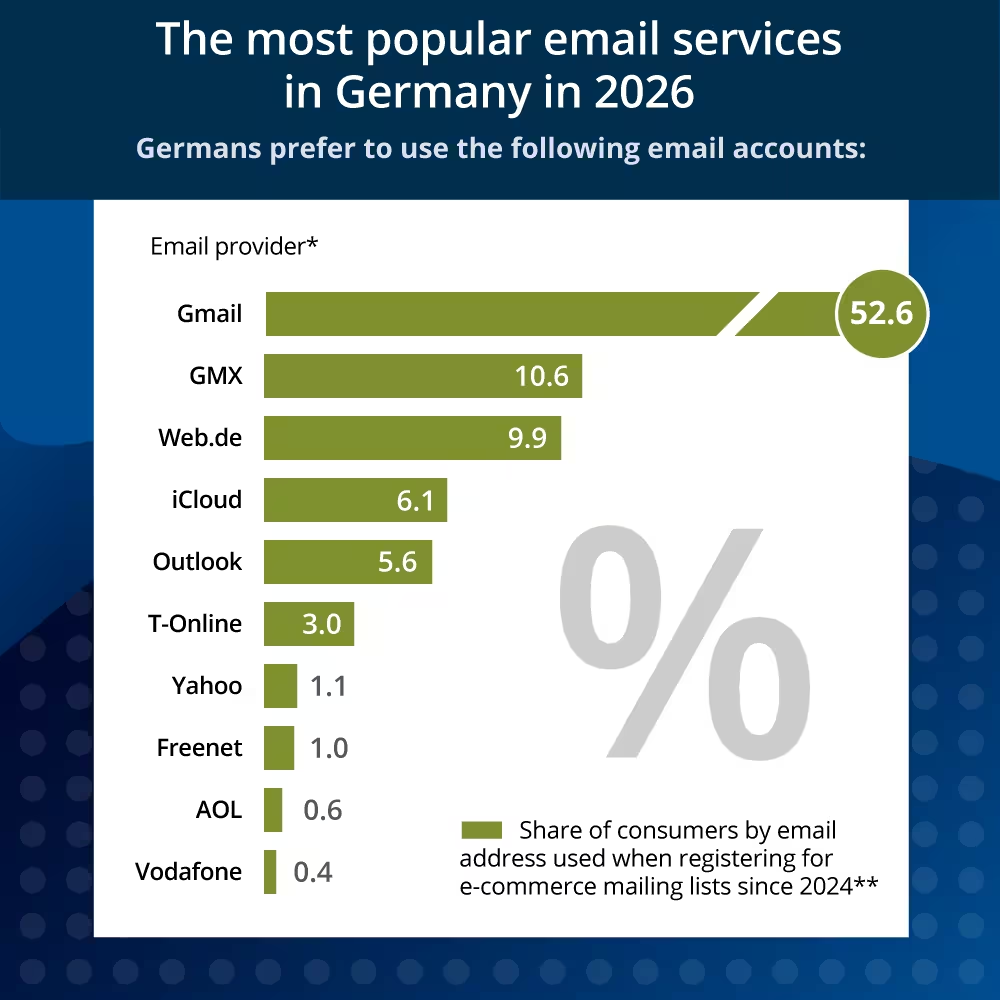
Looking at the 28.2 million newly registered email addresses since 2020, the picture becomes much clearer: Gmail holds an absolute majority, at 50.9 percent. Since 2024, this figure has risen to 52.6 percent for new registrations.
Therefore, more than one in two new registrations recorded in the analyzed e-commerce mailing lists since 2024 are attributable to Gmail. Convenience is certainly a key driver here. Social logins (e.g., logging in with Google) and autofill functions on Android smartphones are establishing Gmail as the preferred choice for online shoppers in Germany.
iCloud Mail is on the rise. Apple overtakes Outlook and T-Online.
Apple provides further evidence of the market shift. In the overall list, iCloud ranks sixth with 3.8 percent. Among new registrations since 2024, however, iCloud has already reached 6.1 percent, overtaking both T-Online (3.0 percent) and Microsoft’s Outlook (5.6 percent) for the first time.
GMX and Web.de remain significant players.
Despite US dominance, German email providers are not disappearing from the market. Combined, GMX and Web.de addresses are still used by nearly 22 percent of Germans for new registrations since 2020. Compared with historical figures, however, the trend shows a significant decline.
Most-Used Email Services in Germany: New Registrations in E-Commerce Compared with the Total User Base
The Email Inbox with Purchase Intent
Anyone scrutinizing our figures will notice a discrepancy with well-known surveys. For example, the Convios study on internet communication, commissioned by United Internet, shows that the group’s own services, GMX and Web.de, together account for over 50 percent of the market share for private email accounts. The difference lies in the methodology. Surveys capture respondents’ self-perception; as soon as data protection or "email made in Germany" is mentioned, the answers shift. We didn't ask anyone. Instead, we counted which email addresses were actually entered at checkout and when signing up for newsletters on German online shops.
Our data shows that the majority of Germans choose Gmail when it comes to online shopping. For your campaign planning, this is the crucial piece of information. A shrinking proportion of your mailings reach the inbox associated with a GMX FunDomain, such as '@baldmama.de,' where promotional content can be disruptive when sandwiched between utility bills and birthday invitations. Secure email accounts with providers such as Posteo or Mailbox.org are virtually nonexistent in our analysis (together, they account for just 0.3 percent). Marketing campaigns predominantly end up in inboxes that consumers open with the clear intention to buy, whether to find deals, seek inspiration, shop, or check delivery updates.
Disposable email addresses also play no role in this commercial environment. Among the 49.2 million active e-commerce addresses we identified, only 1,118 were disposable, representing 0.002 percent. This is partly because buyers want to ensure they receive transactional messages, such as order confirmations. Secondly, most shop systems filter out suspicious domains as early as the account creation stage, so such addresses do not appear in the database.
Marketing strategy: What These Findings Mean for Your Email Marketing
Trust remains vital in every inbox, and is even becoming more critical. Whether using Gmail, United Internet’s services (GMX, Web.de), Outlook, or increasingly, Apple Mail, marketers should prioritize adopting the BIMI (Brand Indicators for Message Identification) standard. Combined with a VMC or Common Mark Certificate and a strict DMARC setup, BIMI is currently the only standardized way to display your logo in different providers' inboxes and be recognized as a trustworthy sender.
Although Gmail is expanding its position as the market leader in Germany, unfortunately, the Google Mail apps remain a technical hindrance. Support for modern CSS and HTML5 standards will remain limited even in 2026. This severely limits the scope of creative, interactive campaigns: native video embeds, forms directly within the email, and complex interactive menus can only be implemented with considerable effort.
In our view, the effort required to use Google’s AMP for Email as a workaround is not worthwhile for most advertisers because the technology is too complex and isolated. At the same time, the shift in the user base toward Gmail raises a new strategic question: Is United Internet’s paid whitelisting service, Trusted Dialog, worth the cost? Trusted Dialog offers advantages on GMX and Web.de, such as a trust seal and guaranteed inbox placement, sometimes combined with enhanced Smart Inbox previews. However, you should rigorously assess whether these benefits justify the costs based on the specific distribution structure of your email mailing list. The shrinking market share of GMX and Web.de increases the pressure on this calculation.
From strategy to implementation, here are some practical tips for Germany’s most popular email services.
What do these shifts mean for the implementation of your email campaigns? Miriam Bredow, Head of MarTech Services at Publicare and an email HTML expert, has compiled a list of things to keep in mind when creating emails for the most important inboxes.
Gmail optimization for newsletters
- Keep your HTML documents under the 102 KB limit. Otherwise, depending on the app and usage context, Gmail may truncate the message, and recipients will have to reload the full message. In the worst case, this will corrupt your layout and block the tracking pixel.
- Consider Google Gemini: The AI can override the preheader. Therefore, the first 90 to 120 characters of your email should get straight to the heart of the campaign’s key message.
- Make use of annotations for the Promotions tab as well. This feature allows you to display product images and discount codes in the inbox list, even before anyone opens the email.
Dealing with Apple Mail: Focus on clicks rather than open rates
The increase in iCloud addresses raises concerns that Apple’s Mail app with Mail Privacy Protection (MPP) is being used more widely. This skews the open rates of your emails. Say goodbye to open rates as your main metric, and shift your strategic focus to clicks and hard conversions.
Mobile optimization, a clean layout in Dark Mode, and thumb-friendly call-to-action buttons are essential for both Gmail and Apple email addresses because these users primarily open their emails on mobile devices.
The Outlook challenge: Design for Degradation
Adopt a “design for degradation” approach. Use a fluid-hybrid layout with fixed tables for classic Outlook clients.
Think carefully about which "legacy" Outlook versions you want to optimize your templates for. However, even the "new Outlook" has a few peculiarities regarding buttons, backgrounds, and spacing for which you should use specific Outlook hacks.
GMX and Web.de
GMX and Web.de are very restrictive in terms of CSS support. However, with clean HTML code, emails can still be effectively designed for these apps and web clients.
Conclusion: Robust email design trumps pixel-perfect design.
No email design looks pixel-perfectly identical everywhere. However, the layout must not break on any of the major providers. Publicare is happy to support you in optimizing your campaigns for all usage contexts. Contact us for expert advice.
Methodology
Authors: Marion Krohn (Head of Marketing) and Robert Harnischmacher (Managing Director), along with the Publicare team.
Publicare evaluated a sample of 49.2 million anonymized email addresses from the German B2C e-commerce sector during the survey period from May to July 2026 for this market analysis. To identify meaningful trends regarding current inbox preferences, two historical segments were analyzed separately from the total sample: 28.2 million email addresses registered since 2020 and 9.9 million registered since 2024. All data originates from verified, active customer mailing lists, and it was all aggregated in a fully anonymized form for this study.